
Generative AI is Older Than You Think: The Brain as a Prediction Machine
Series: Evolutionary Blueprint of AI. GenAI is not a new invention. The biological generative model has been refining its latent representations for millions of years. Explore how the brain’s evolutionary shift from reactive steering to proactive simulation defines the frontier of AI.
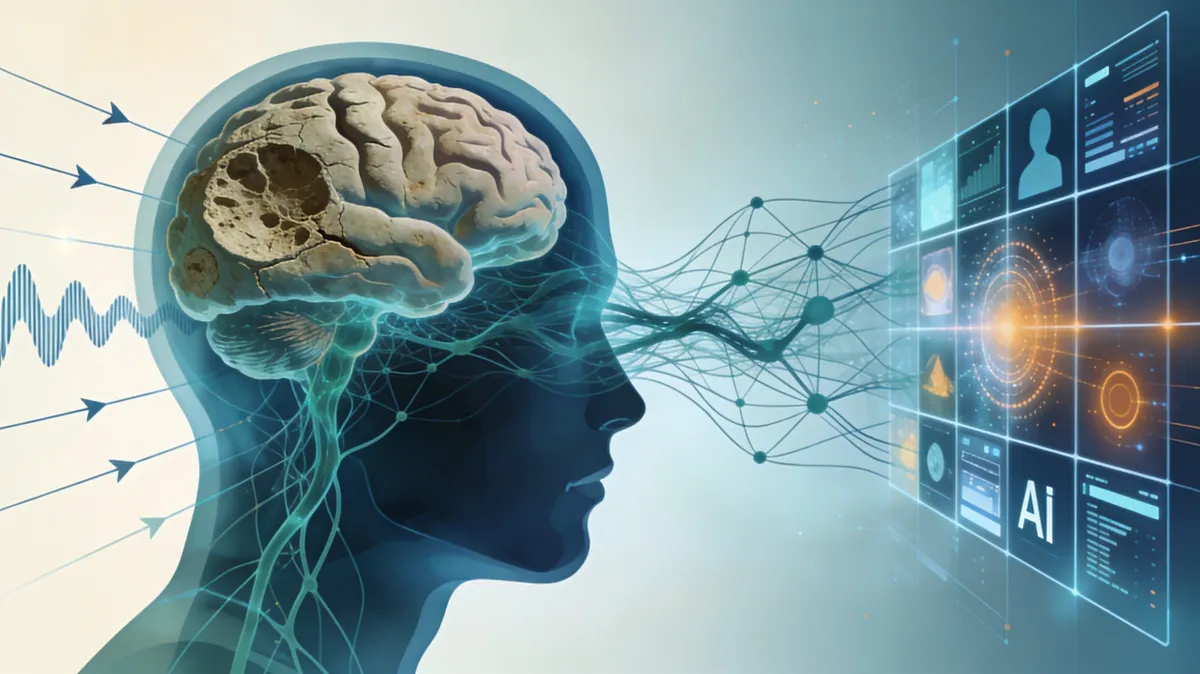
The Illusion of Passive Perception
Welcome back to our exploration of intelligence. In our previous article, we discussed the missing causal architecture in modern Large Language Models. Today, we turn our attention to a striking similarity between artificial and biological systems.
For centuries, science and philosophy operated on a flawed assumption about human psychology and perception. We believed the brain acted like a passive camera. We assumed our eyes took in raw pixels of light, sent them to the visual cortex, and our brain gradually built a picture of reality from the bottom up. In data science terms, we assumed human perception was a standard feed forward neural network.
However, evolutionary neuroscience tells a radically different story. As Max Bennett highlights in his book "A Brief History of Intelligence", the brain does not passively receive reality. It actively generates it. You are walking around with a highly optimized, biological generative model inside your skull. Understanding this mechanism is crucial for data scientists and technology executives who want to build the next generation of adaptive AI systems.
Predictive Coding: The Biology of Self Supervised Learning
To understand how the brain generates reality, we must look at a theory known as predictive coding. The mammalian brain, particularly the neocortex, is fundamentally a prediction machine.
Instead of waiting for sensory data to arrive and then figuring out what it means, your brain constantly predicts what it is going to experience next. It sends these predictions down from higher cognitive areas to lower sensory areas. Your sensory organs then compare this prediction against the actual incoming data.
If the prediction perfectly matches the sensory input, the data is essentially ignored. The brain only passes information upward when there is a "prediction error" or a surprise. This error signal is then used to update the internal model so it can make better predictions in the future.
For CTOs and data scientists, this architecture should sound incredibly familiar. It is the biological equivalent of self supervised learning. Large Language Models are trained using a similar objective function. They predict the next word in a sequence, calculate the error when they are wrong, and update their weights through backpropagation to minimize future surprise. The fundamental algorithm of the human cerebral cortex and the fundamental algorithm of ChatGPT share the exact same goal. Both systems learn by minimizing prediction errors.
A Philosophical Paradigm Shift
When we view the brain through this lens, the philosophical implications are staggering. If you only consciously process the errors in your brain's predictions, then the world you experience every day is not objective reality. It is a simulation generated by your brain. The neuroscientist Anil Seth famously refers to human perception as a "controlled hallucination."
From a philosophical standpoint, this aligns closely with the ideas of Immanuel Kant. Kant argued that we never experience the universe as it truly is in itself. We only experience the phenomenal world constructed by our minds.
This brings up a critical question for AI development. When we train a multi modal AI to predict the next frame of a video or the next token of text, we are forcing it to construct its own phenomenal reality. If an AI system hallucinates a fact, it is not malfunctioning in the biological sense. It is simply generating a prediction that failed to align with our shared human consensus. Hallucination is not a bug in generative models. It is the exact feature that makes intelligence possible. The challenge is not stopping AI from hallucinating, but rather grounding its hallucinations in physical reality.
The Real Time Adaptation Gap
Why does this matter for enterprise AI strategy? While the core concept of prediction is shared between AI and the brain, the implementation is vastly different.
Current machine learning models have distinct training and inference phases. Once an LLM is deployed to production, its weights are frozen. It can predict the next word, but it cannot learn from its mistakes in real time. If the world changes, the model degrades.
Your brain does not work this way. Biological predictive coding happens continuously. Your generative model updates its synaptic weights on the fly every single second based on prediction errors. This is the holy grail for enterprise artificial intelligence. To achieve true autonomy, we must move away from static models that require massive, expensive retraining runs. We need dynamic systems that update their internal parameters continuously as they interact with novel data.
Recognizing that generative AI is an ancient biological concept provides us with a clear roadmap. Nature has already proven that a continuous prediction engine is the most efficient way to navigate a chaotic universe.
Takeaway
The human brain is fundamentally a predictive engine that operates via a biological version of self supervised learning. We do not passively perceive the world. We actively generate our reality and only process the errors in our predictions. While modern AI shares this core predictive mechanism, it lacks the biological brain's ability to update its generative model continuously in real time. For business leaders, the future of AI lies in bridging this gap to create models that learn and adapt dynamically from their environment.
Next
In our next article, "Why Robots Can't Load the Dishwasher (Yet)", we will explore one of the most persistent mysteries in artificial intelligence. Why can a computer write brilliant poetry and beat grandmasters at chess, but completely fail to fold a towel or clear a dinner table? We will delve into Moravec's paradox and discover why physical movement is the hardest computational problem evolution ever solved.
Series Parts
Series: The Evolutionary Blueprint of Artificial Intelligence
Theme 1: The Architecture of Intelligence