The Mathematical Soul of Language: A Guide to Text Vectorization
Teaching a computer to understand language transforms abstract thoughts into numbers via vectorization, bridging human nuance and machine logic. From tokenization and DTM to TF-IDF, embeddings, and Transformers, this evolution enables semantic calculations like "King - Man + Woman ≈ Queen."
Introduction: Why Computers Must "Calculate" Language
Teaching a computer to understand human language is one of the most profound challenges in modern science; it is akin to teaching a machine to feel the texture of a thought. While humans perceive the rich, abstract meaning behind a sentence, a computer remains a fundamentally rigid calculator. It does not see "beauty" or "intent". It only sees numbers.
To bridge this gap, we use vectorization. This is the mathematical bridge that allows us to perform operations on abstract concepts by transforming text into a series of coordinates in a multi-dimensional space. By converting language into vectors (lists of numbers), we allow machines to "calculate" relationships, effectively translating the fluid nature of human speech into the precise logic of mathematics.
Before we can map these complex meanings, we must first break the silence of the raw text and prepare it for its numerical transformation.
Step 1: Tokenization and Cleaning the Slate
Before a computer can analyze a document, the "raw" data must be meticulously prepared. You cannot calculate a paragraph in its entirety; you must first isolate its individual units of meaning to create a structured foundation.
The Prep Work
- Tokenization: This is the foundational process of breaking raw text into manageable pieces called "tokens", usually individual words.
- Stop Word Elimination: Common words like "the," "and," or "for" often carry minimal unique information. By removing these, we strip away the "noise" to focus the computer’s attention on the keywords that define the document's essence.
- Determining the Vocabulary: The computer compiles a master list of every unique word across the entire dataset. This master list serves as the "dictionary" for the mathematical map we are about to build.
Once these tokens are isolated and the noise is removed, they must be organized into a structure that the computer can systematically read and compare across different documents.
The Classic Blueprint: The Document-Term-Matrix (DTM)
The first historical method for computer language "vision" is the Document-Term-Matrix (DTM). In this system, we simply record whether a word from our master vocabulary appears in a specific document. This creates a count-based record where every word is treated as an independent column.
Example: A Comprehensive Document-Term-Matrix
The following table demonstrates how a computer "sees" various phrases through simple word presence (1) or absence (0).
| Document \ Term | Looking | cheap | flight | Where | should | stay | thanks | answer | Nearest | train | station | car | airport |
|---|---|---|---|---|---|---|---|---|---|---|---|---|---|
| "Looking for cheap flight?" | 1 | 1 | 1 | 0 | 0 | 0 | 0 | 0 | 0 | 0 | 0 | 0 | 0 |
| "Where should I stay?" | 0 | 0 | 0 | 1 | 1 | 1 | 0 | 0 | 0 | 0 | 0 | 0 | 0 |
| "Thanks for your answer" | 0 | 0 | 0 | 0 | 0 | 0 | 1 | 1 | 0 | 0 | 0 | 0 | 0 |
| "Nearest train station" | 0 | 0 | 0 | 0 | 0 | 0 | 0 | 0 | 1 | 1 | 1 | 0 | 0 |
| "Looking for a car" | 1 | 0 | 0 | 0 | 0 | 0 | 0 | 0 | 0 | 0 | 0 | 1 | 0 |
| "Train to airport" | 0 | 0 | 0 | 0 | 0 | 0 | 0 | 0 | 0 | 1 | 0 | 0 | 1 |
The "So What?"
While this method is straightforward, it suffers from significant deficiencies. It treats documents as a "bag of words," meaning it captures the vocabulary but completely ignores word order and semantics. Furthermore, as the vocabulary grows, the matrix becomes mostly filled with zeros (sparse), leading to high memory usage and the "curse of dimensionality."
To move beyond simple counting, we need a method to identify which words actually carry the most "weight" in a conversation.
Refining the Lens: The Role of TF/IDF
Not all words are created equal. In a collection of travel documents, the word "travel" might appear in every single file, making it useless for distinguishing one document from another. TF/IDF (Term Frequency / Inverse Document Frequency) is an optimization used to correct this imbalance.
Key Insight: TF/IDF acts as a mathematical filter. It rewards "rare but relevant" words that appear frequently in a specific document but rarely in the overall collection. Conversely, it penalizes "common but noisy" words that appear everywhere, ensuring they don't drown out the meaningful data.
While TF/IDF helps us identify important words, it still treats words as isolated entities. It does not understand that "train" and "station" are conceptually linked. For that, we require a paradigm shift.
The Paradigm Shift: Word Embeddings and Semantic Space
Traditional vectorization assigned numbers to words arbitrarily (e.g. Apple = 1, Orange = 2). This failed because the distance between 1 and 2 holds no inherent meaning; it doesn't tell the computer that an apple and an orange are both fruits.
Modern Word Embeddings (such as Word2Vec) revolutionize this by using Training with simple plain text to place words into a dense coordinate system where the physical distance between points represents semantic similarity.
Counts vs. Concepts
| Feature | Traditional Vectorization (DTM/TF-IDF) | Modern Word Embeddings (e.g., Word2Vec) |
|---|---|---|
| Information Density | Sparse (Mostly zeros; causes high memory/computational waste) | Dense (Rich, continuous data in every number) |
| Spatial Meaning | Meaningless distances | Distances and placement define similarity |
| Dimensionality | Massive (One dimension for every unique word) | Compact (Typically 100–300 dimensions) |
In this new space, the position of a word is its meaning. By training on vast amounts of text, the model learns that words appearing in similar contexts should be placed near each other in this 300-dimensional map.
The Magic of Vector Equations
Once words are mapped as precise coordinates, we can perform literal algebra on human concepts. This is the practical application of vector equations.
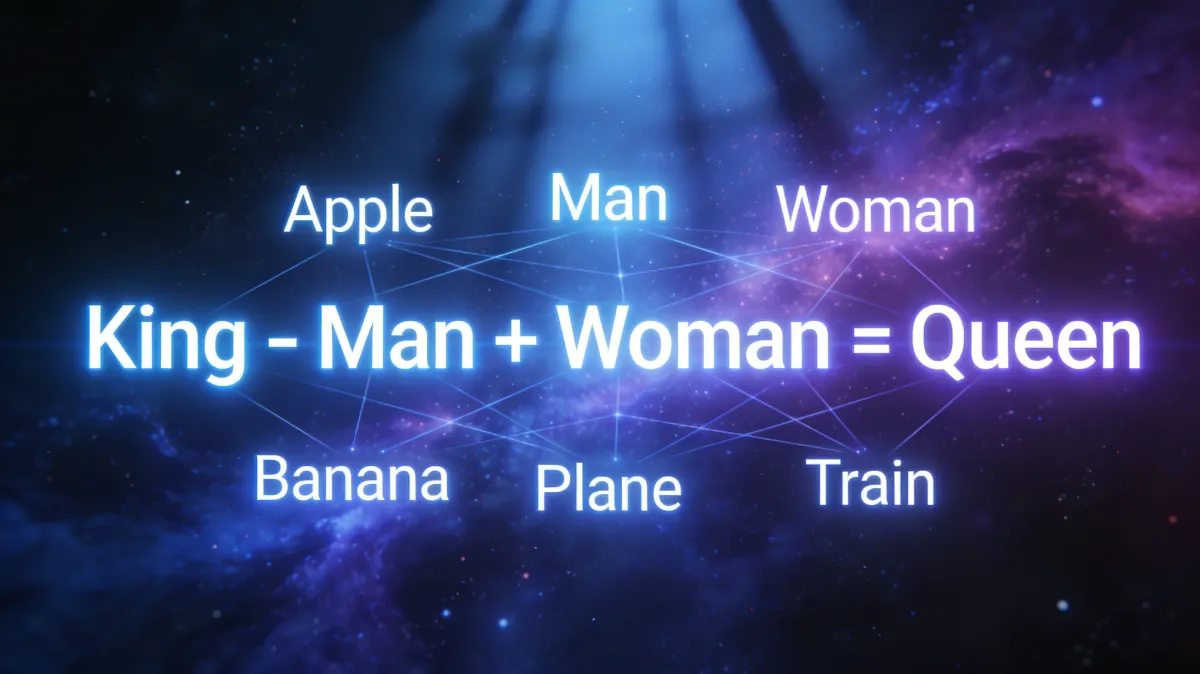
King - Man + Woman = Queen
This is not a mere metaphor. In a well-trained embedding space, if you take the vector for "King," subtract the vector for "Man," and add the vector for "Woman," the resulting coordinates will land remarkably close to the vector for "Queen."
Strengths and Structural Limitations
- Successes: These models excel at identifying Synonyms and general Similarity (e.g. "flight" is near "plane").
- Key Limitations: Because these embeddings are static, they assign a single fixed position to each word. This causes them to fail at handling Homonyms (a "bank" could be a river edge or a financial institution) and broader Context.
To overcome the limitation of static words, the computer must be able to look at the words surrounding a token to determine its current role.
Beyond Static Words: The Rise of Transformers
The current state-of-the-art is the Transformer architecture. Transformers solve the context problem through a mechanism called "Attention" (referencing). Instead of looking at a word in isolation, the model asks: "Which words in this sentence relate to which?"
There are two primary branches of this technology:
- Encoder (e.g. BERT): These focus on "Understanding" and deep referencing. They look at the entire sentence simultaneously to determine the exact context of every token.
- Primary Applications: Annotation/NER (Named Entity Recognition) and Retrieval/RAG (Retrieval-Augmented Generation).
- Decoder (e.g., GPT): These focus on "Prediction" and text continuation (Next Token Prediction). They are designed to guess the most likely following word.
- Primary Applications: Question Answering and Text Generation.
Conclusion: The Learner’s Map
We have evolved from simple tallies in a matrix to complex neural networks that "reference" the subtle relationships between words. The journey of text vectorization follows a sophisticated path:
- Raw Document: The starting point of unstructured human thought.
- Tokens: Breaking the silence into individual data units.
- Matrix (DTM): A census of words that identifies basic patterns.
- Embeddings: Mapping words into a "semantic space" where coordinates equal concept.
- Contextual Understanding: Using Transformers and "attention" to understand how words interact dynamically.
These mathematical vectors are the "DNA" of modern AI assistants like DeepSeek, Qwen, and GPT. By mastering the art of turning language into math, we have finally given machines a way to navigate the nuances of human expression.
Summary Checklist
- [ ] Tokenization: The initial break-down of text into pieces.
- [ ] DTM: The "Bag of Words" method that counts occurrences.
- [ ] TF/IDF: An optimization to highlight important words and ignore noise.
- [ ] Embeddings: Dense, 100-300 dimensional spaces where proximity equals meaning.
- [ ] Transformers: Using the attention mechanism (referencing) to master context and prediction.