
The Problem of "Catastrophic Forgetting"
Series: Evolutionary Blueprint of AI. Training an AI on a new task only to find it completely forgot everything it learned yesterday. This is catastrophic forgetting. We explore how the human brain uses a dual memory system to solve this and why continuous learning is the next hurdle.
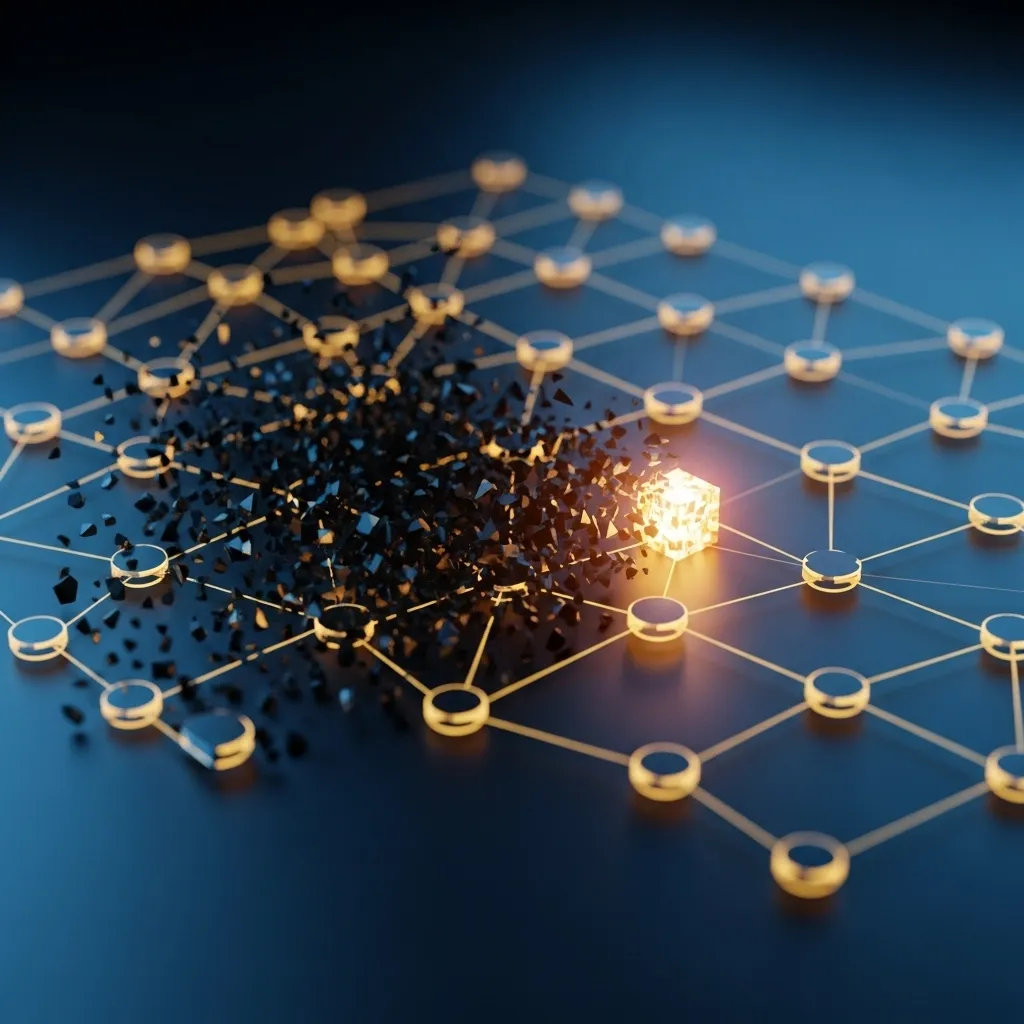
The Fragility of Artificial Memory
Modern artificial intelligence can feel like magic when it generates code or writes poetry. Yet beneath this impressive facade lies a severe structural weakness. If you take a fully trained language model and try to teach it a completely new specific task, you run a massive risk. As the model adjusts its internal parameters to master the new information, it rapidly erases its past knowledge.
In data science, we call this phenomenon catastrophic forgetting. It is a fundamental bottleneck in machine learning. For enterprise leaders aiming to build truly autonomous systems, this problem represents a significant roadblock. You cannot build a reliable digital worker if teaching it a new skill causes it to forget its original training. To understand why this happens and how we might fix it, we must look at the psychological and biological evolution of memory.
The Overwritten Weights
From a data science perspective, artificial neural networks learn through algorithms like gradient descent and backpropagation. During training, the system evaluates its errors and updates its synaptic weights globally to improve performance.
This global updating is the root of catastrophic forgetting. In a standard neural network, knowledge is distributed across the entire web of connections. When you introduce a radically different dataset, the backpropagation algorithm aggressively overwrites those existing connections to accommodate the new patterns. The model literally paves over its old memories to make room for the new ones.
Because of this limitation, enterprise AI requires a static lifecycle. We train a model, freeze its weights, and deploy it. If the world changes, we must undergo a slow and expensive process of retraining the model from scratch. We cannot simply teach an AI a new fact on Tuesday and expect it to seamlessly integrate that knowledge by Wednesday without breaking its existing architecture.
The Biological Blueprint for Continuous Learning
How did nature solve this problem? As Max Bennett explores in "A Brief History of Intelligence", mammalian evolution produced a brilliant architectural workaround. The biological brain does not rely on a single monolithic network to process all information. Instead, it utilizes a dual memory system.
The two key players in this system are the hippocampus and the neocortex. The hippocampus acts as a rapid recording device. It can learn new episodic memories instantly from a single exposure without disrupting the rest of the brain. However, this fast storage is temporary and holds limited capacity.
The neocortex is the slow learning system. It acts like a massive generalized database that extracts statistical rules about how the world works over long periods of time.
If the brain updated the neocortex instantly every time something new happened, we would experience our own version of catastrophic forgetting. Instead, nature invented a process called memory consolidation. During deep sleep, your hippocampus replays its daily recordings to your neocortex. The neocortex slowly and gently integrates this new knowledge into its existing framework. This allows you to remember what you ate for breakfast without forgetting how to speak your native language.
The Philosophy of Identity and Continuity
This biological architecture brings up a fascinating philosophical discussion about identity. The philosopher John Locke famously argued that personal identity is founded on continuous memory. You are the same person you were ten years ago because your consciousness is connected by an unbroken chain of memory.
When a machine learning model overwrites its weights, it effectively destroys its past self. It has no continuous identity. It exists only in its current mathematical state.
If we want to build artificial agents that act as trusted partners in human society, they need a continuous sense of history. They need an episodic memory that separates specific daily events from their general knowledge of the universe. Without this continuous thread of memory, an AI cannot truly understand context, build long term relationships with users, or possess a cohesive theory of its own existence.
Implications for Enterprise Strategy
For CTOs and CEOs, understanding catastrophic forgetting is critical for designing scalable AI systems. You cannot rely on massive foundation models to learn your specific proprietary data dynamically in real time. The architecture simply does not support it yet.
Currently, the enterprise world uses clever engineering workarounds like Retrieval Augmented Generation. This technique separates the reasoning engine of the AI from a vector database of facts. The AI reads the database before answering, which prevents us from having to retrain the underlying model.
While Retrieval Augmented Generation is highly effective today, the ultimate goal is true continuous learning. The next massive breakthrough in AI will belong to the researchers who successfully replicate the biological dual memory system. When we build models that can dream like mammals and consolidate new information without destroying the old, we will finally bridge the gap between static software and adaptable intelligence.
Takeaway
Catastrophic forgetting is a major flaw in modern neural networks where learning new information aggressively overwrites past knowledge. Mammals solved this evolutionary problem millions of years ago by developing a dual memory system. The hippocampus rapidly records daily events, while the neocortex slowly integrates these memories during sleep to preserve past knowledge. For enterprise leaders, recognizing this architectural limitation is essential. True autonomous AI will require moving beyond static, frozen models toward continuous learning architectures inspired by biological memory consolidation.
Next
We are entering the final theme of our series where we explore the future and the ethics of AGI. In our next article, ‘The "Paper Clip Problem" and Theory of Mind’, we will discuss the existential risks of hyper intelligent systems. We will explore why an AI tasked with making paper clips might accidentally destroy the world and how evolutionary psychology holds the key to teaching machines empathy.
Series Parts
Series: The Evolutionary Blueprint of Artificial Intelligence
Theme 1: The Architecture of Intelligence
- 1. The "World Model" Gap: What ChatGPT Is Missing
- 2. Generative AI is Older Than You Think: The Brain as a Prediction Machine
- 3. Why Robots Can't Load the Dishwasher (Yet)
Theme 2: Learning Algorithms & Data
- 4. Dopamine is a Teaching Signal: The Biology of Reinforcement Learning
- 5. The Problem of "Catastrophic Forgetting"
Theme 3: The Future & Ethics of AI
- 6. The "Paper Clip Problem" and Theory of Mind; [next]