
Why Robots Can't Load the Dishwasher (Yet)
Series: Evolutionary Blueprint of AI. Moravec's paradox. We explore why evolution spent millions of years perfecting movement and why embodied cognition is the missing link for enterprise robotics.
The Paradox of Hard and Easy Problems
As a technology leader, you have likely noticed a frustrating discrepancy in the AI marketplace. You can deploy a generative model today that drafts flawless legal contracts or debugs complex software. However, if you want a robot to fold laundry, navigate a cluttered warehouse, or load a dishwasher, you are met with astronomical costs and fragile solutions.
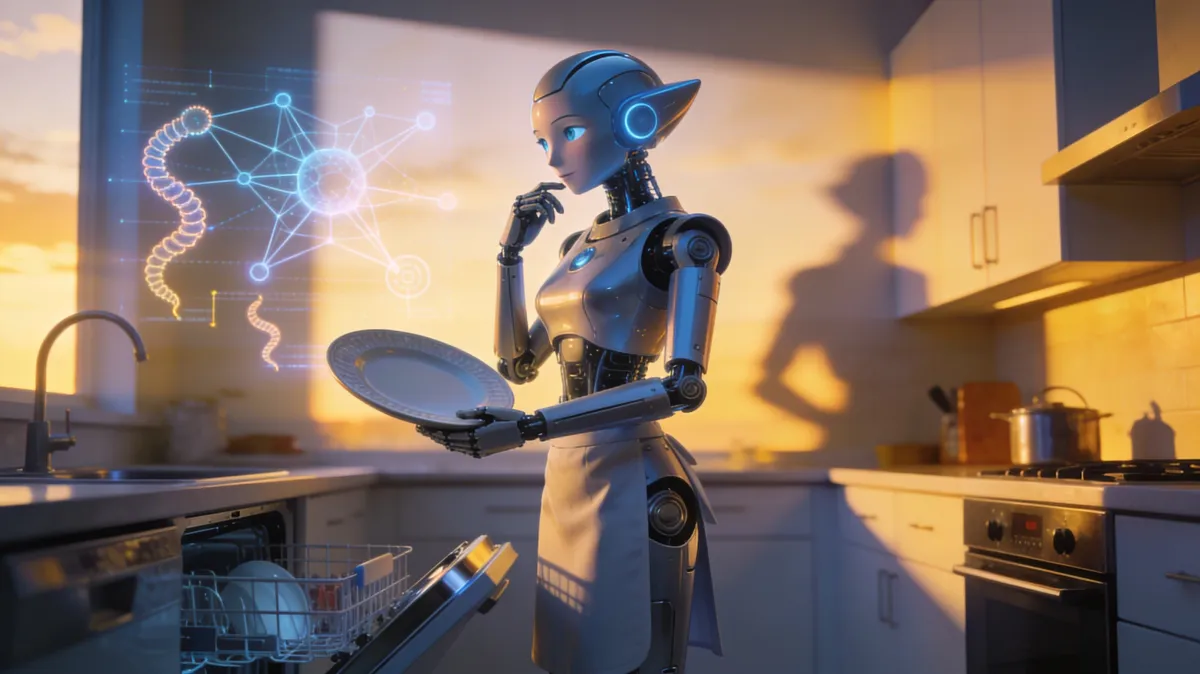
This phenomenon is known as Moravec's paradox. In the 1980s, researchers discovered that high level reasoning requires very little computation, while low level sensorimotor skills require enormous computational resources. From a data science perspective, this seems counterintuitive. Why is playing grandmaster level chess computationally trivial compared to picking up a slippery soap bottle?
To understand this bottleneck, we must look to evolutionary history. As Max Bennett details in "A Brief History of Intelligence", the timeline of biological evolution provides a perfect blueprint for why modern robotics struggles. Evolution did not start with logic. It started with movement.
The Evolutionary Engine of Movement
When we look at the psychological and biological development of the brain, we see that abstract thought is a very recent evolutionary add on. The earliest nervous systems evolved in ancient oceans for one primary purpose. That purpose was physical navigation.
Early bilaterians needed to solve the incredibly complex problem of steering. They had to coordinate muscles, process sensory feedback, and navigate a three dimensional environment filled with unpredictable physical forces. Evolution spent hundreds of millions of years optimizing the algorithms for balance, spatial awareness, and fine motor control. In contrast, abstract human language and logic evolved only in the last few hundred thousand years.
We perceive physical movement as "easy" because our brains have dedicated massive, highly optimized neural real estate to handling it subconsciously. We perceive abstract math as "hard" because it is a novel hack running on top of that ancient sensorimotor hardware. Artificial intelligence development took the exact opposite path. We built machines to do the math first. Now, we are trying to reverse engineer hundreds of millions of years of evolutionary physics.
The Data Science Bottleneck in Robotics
For data scientists and CTOs, the distinction between cognitive AI and physical robotics comes down to the nature of the data and the action space.
Large Language Models operate in a discrete, frictionless environment. A language model predicts the next token from a fixed vocabulary. If it makes a mistake, the penalty is simply a bad sentence.
Robots operate in a continuous, high dimensional physical space governed by chaotic rules. A robotic arm trying to pick up a wet plate must calculate friction, gravity, torque, and tactile feedback in real time. If the robot makes a tiny miscalculation, the plate shatters.
Furthermore, data scientists face the notorious "sim to real" gap. We can train robotic algorithms inside virtual physics simulators for millions of iterations. However, virtual simulators cannot perfectly replicate the infinite variables of the real world. A change in lighting, a worn out gear, or an unexpected shadow can completely break a reinforcement learning model that performed flawlessly in a simulation. The physical world is the ultimate, unforgiving dataset.
The Philosophy of Embodied Cognition
This brings us to a crucial philosophical concept known as embodied cognition. For decades, classical cognitive science viewed the brain as a computer trapped in a skull. Philosophers and scientists assumed that intelligence was just a matter of processing abstract symbols.
Embodied cognition shatters this assumption. It argues that the mind cannot be separated from the physical body. True understanding of the world requires physical interaction. When you understand the concept of a "cup", you do not just have a dictionary definition in your head. Your understanding is grounded in the physical memory of holding the cup, feeling its weight, and knowing that it will break if dropped.
Current AI models are essentially brains in vats. They have mapped the linguistic connections between words, but they have no physical grounding for what those words actually mean. Until artificial systems possess a body that interacts with the physical laws of the universe, their intelligence will remain fundamentally alien and incomplete.
Implications for the Enterprise
For CEOs and CTOs planning their automation strategies, Moravec's paradox provides a critical lens. You should aggressively pursue AI for cognitive, data heavy tasks where the environment is digital and rules based.
However, you must exercise extreme patience and caution with physical automation in unstructured environments. The timeline for fully autonomous household robots or generalized humanoid workers is much longer than the timeline for digital Artificial General Intelligence. We are fighting millions of years of evolutionary complexity. The companies that ultimately solve robotic manipulation will not just be writing better code. They will be synthesizing artificial nervous systems.
Takeaway
Moravec's paradox teaches us that high level reasoning is computationally cheap, while physical movement is incredibly expensive. Evolution spent millions of years perfecting sensorimotor control, making physical interaction the foundation of true intelligence. Because modern AI lacks a physical body and operates in frictionless digital environments, it struggles immensely with basic physical tasks. Enterprise leaders must understand that true artificial intelligence requires embodied cognition, making the leap from digital chatbots to physical robots the hardest challenge in the tech industry.
Next
We have explored the architecture of the brain and the challenges of physical movement. Now, we must ask how biological systems actually learn from their environment. In our next article, "Dopamine is a Teaching Signal: The Biology of Reinforcement Learning", we will uncover the biological origins of one of the most powerful algorithms in data science. We will explore how nature invented reinforcement learning millions of years before computer scientists did.
Series Parts
Series: The Evolutionary Blueprint of Artificial Intelligence
Theme 1: The Architecture of Intelligence
- 1. The "World Model" Gap: What ChatGPT Is Missing
- 2. Generative AI is Older Than You Think: The Brain as a Prediction Machine
- 3. Why Robots Can't Load the Dishwasher (Yet)
Theme 2: Learning Algorithms & Data